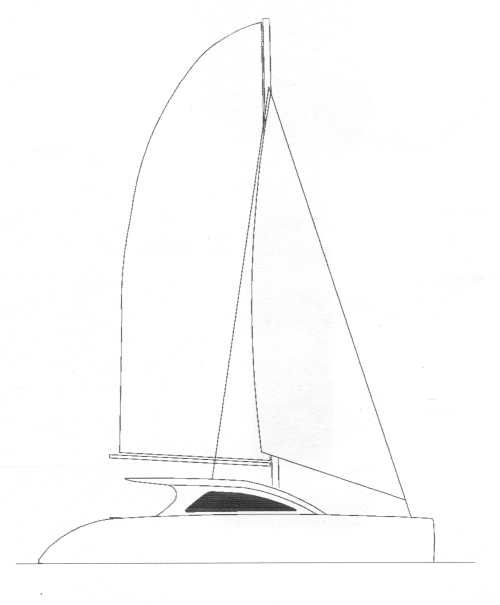
|
It first started as a realisation
that I was talking myself into a plan that I was meant to be
researching for others. In TCP # 13 I did an article “The Multi Eye for the Mono Guy”.
The piece was a great success and since I posted it to the web
site (see technical articles) has been a steady download for
tens of thousands of readers. At that time two things had become
apparent, first was that TCP was definitely not going to go away,
my little hobby had gone wrong and I was no longer a happily
retired person, aspiring to peaceful old fart status and.. it
was becoming just as clear that our beloved old “WhiteBird”
was exactly the wrong kind of boat for this now uncontrollable
life style. Big thundering, high maintenance steely with not
quite enough room to fit the gear for publishing TCP. A great
boat for our original purpose, blue water with a circumnav up
my sleeve, but a total encumbrance for our new reality, coastal
cruising and workaboard. Besides, (incidentally of course) I
had been on a few fast multis and I liked it!
So, what is the perfect solution? First
on my list of required attributes was low maintenance. That means
plastic. Now before I start WWIII with the fans of alloy or other
materials, I grant there is some subjectivity in the choice but
overall a glass fibre composite fits the bill best. It’s
also light... which means (incidentally of course) that the boat
might be fast.
The new boat would have to have room for
the computers and printers used to publish TCP and still be comfortable
for long term liveaboard. A catamaran of about 40 feet would
have the accommodation space in a bridge deck configuration to
allow this. Also the publishing rig would be light relative to
more common types of stuff so wouldn't burden a weight sensitive
craft too much.
The chosen boat would have to be affordable...
BUGGER!! It was easy up till now. A new or good condition second
hand cat of that size and construction is in the $350 to $500K
range even for our modest fitout requirements. This kind of expense
just couldn't be justified. The only way out is to build her,
sweat equity.
I would have to look at a more utilitarian
approach or I would take an unacceptably long time to complete
her. I needed a design that would make a virtue (as much as possible)
out of simplicity. Graceful curves would have to be substituted
for lines and flat panels.
Anyway.. with sketch book in hand and with
pictures of several boats in front of me, a shape took form while
sitting in the shed. This was Oram’s kind of thing and I
was heading that way on a property search anyway, so I took my
sketches and ideas and drove from Bowen down to Hervey Bay.
I found myself sitting with Bob Oram in
front of his powerful modern computer working on a program right
out of the DOS dark ages. “Plyboat” is something you
can download for about the cost of a slab of beer. It does work
on hulls but is very limited for decks, cabin and other parts.
We did have some exciting times arguing about sheer. Bob’s
first version was quite flat like the 44C but I liked the effect
from his 38 Mango II design. A halfway point was printed out
and that is what I have now. With the objective of simplicity,
a cabin top was drawn as well and though I wasn’t thrilled
with my own idea (3) it seemed good enough to leave there until
a better idea came along. The hulls are the big thing, the cabin
design can be changed almost on a whim.
Another trip south with a cabin sketch
I had drawn and a few other ideas and questions... and a boat
I call the Eleven99, has taken shape. . I am proud to have contributed
to the look and the philosophy but required the services of a
pro to make it work. (Update... knowing what I know now I
would have paid the $30 and bought the program, done the homework
and drawn her myself or paid the money to buy a Schionning set
of plans that are more reliably drawn and complete.)
Size;
I wanted a boat that I felt Kay and I could handle and as stated
earlier, would be big enough for the gear. About 40 feet seemed
right but... many marinas are getting touchy about berth sizes
and their insurance companies won’t allow fudging on the
numbers. As we will not be able to avoid marinas because of the
paper and the fact I don’t mind the communities found in
the better marinas, and because many marinas use 12 metres as
a break point in price... 11.99 metre is perfect (thus the name,
eleven99) rather than the 40 foot= 12.2 metre length. That extra
8” could cost a lot of money over time.
Material; Bob
Oram and I had much discussion about this. Whilst Bob Oram was
in favour of duflex panels because of the speed of build, FGI
had a very attractive price on foam as this was being worked
out. I figured out the costs and it seemed that foam and vinylester
resin and glass would come out to roughly half of the cost of
the balsa core Duflex panels from ATL. I had talked to designer/builder,
Bob Burgess earlier who had described how to use that stuff for
a flat panel boat. He suggested lofting up a full length panel
of foam on a flat surface and have two guys working laying the
glass. One mixing resin and spreading and the other wetting the
clothe in, then trimming edges with a Stanley knife whilst green.
Even so it would take more time than the few days it took us
to glue ATL panels together and there would also be the problem
of fumes. Big time! The location of build would have to be deep
within a toxic industrial site. But then the epoxy used on the
ATL panels runs a risk too. I know people that have almost killed
themselves with epoxy poisoning building a boat. It’s an
acquired toxic reaction. Some get it and some can swim in the
stuff with impunity. You can get halfway done and find yourself
a mess... and some have worked on anyway, not willing to abandon
the project in spite of the risks. I considered the options carefully
and hope I made the right choice. As of this writing, I might
advice a person contemplating this or a similar project to consider
foam in some sections. (update... the problems I have encountered
with the Duflex panels has entirely wiped out any gain in assembly
speed though the high cost remains! I now consider any of the
alternatives superior to this product and will be finishing my
boat with something.. anything else.)
Keels or Boards;
This is one area I opted for what could be more complexity. Boards
will probably increase build time over keels and take up some
hull space and be another thing to have a line attached to BUT...
with our kick up rudders and extra skin on the keel panel will
allow us to beach the boat with near impunity.. and with boards
down will allow her to point sky high... and, (are you ready
for it?) reduce wetted area on a run to make her fast!
Auxiliary power;
For cost, simplicity, and weight, the twin 4 stroke outboard
option is right for us. Besides, with motors up and no drag...
she could be fast! (update... electric propulsion has really
gained appeal lately and expect this to be showing up on new
boats more as the year progresses.)
Cabin;
The first sketches showed a very simple thing that was intended
for the easiest construction. Flat panel sides with an overhanging
roof, something like a garden shed frankly. That later was modified
after I thought about how panels could be curved with relative
ease to enhance aesthetics considerably. While Bob and I were
at the computer it occurred to me that reducing the angle of
the forward part of the structure would carry it over the two
forward cabins... why not? This gives more head room, ventilation
and light to them and every ‘wall’ removed simplifies
the boat that much more and satisfies my sense of ‘open
space’ in the bargain. My ideal house would have a wall
around the WC and that's about it. Privacy screens can take care
of those odd times we have guests aboard.
Fitout; Our
experience fitting out WhiteBird gives confidence that this can
go quicker and cheaper than you might think. The number one tool
is to use the least skin and ginger bread possible. Well placed
small bits of fine timber and white surfaces can be amazingly
effective and tidy looking and we won’t need a 30”
flat screen TV to pop up from the bar... We equate comfort with
a lack of clutter... so we plan to live in extreme luxury.
What About the Money; Saved the best for last! OK, here is the scoop
as best I can in short hand. The kit of panels has cost $32K
AUD so far including what ATL Composites thinks should be all
the necessary ingredients to put the thing together (glues, epoxy
resins, tape and clothe etc). This is for the hulls, most bulkheads,
bridgedeck floor and hopefully decks (but I could be short there).
The full kit including bridgedeck cabin top should come in at
about $50K but that still doesn't include materials for boards
and temporary frames and forebeam etc... Figure another $8000.
If I can get an assembled shell to lock up for $65K, I've won.
I’ve allowed a budget of $150K total but I hope we will
beat that. I won’t jinx it by over-speculating and it will
depend on the accessories we want, like a screacher and furler.
... or... |