|

Home Page Sundowners
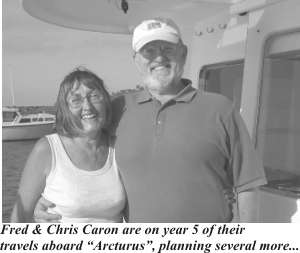
I was knocked down impressed with this story when I first read it.. and still am. This is the true account, beautifully written, of MY "Arcturus's" pacific crossing on her way around the world from the west coast of the USA. As of this day in July 06 she is in Phuket, no doubt making mischief and having a great time!
Now Comes the Storm....
High on a roadside cliff overlooking the sea, an observer stands, braced against the wind, silently watching as an orderly procession of giant ocean waves, remnants of an unnamed and by now forgotten storm, thunderously crash upon boulder-strewn rocks far below, clouds of cold saltwater mist blowing everywhere.
To the observer, there is a pattern to this mosaic, waves are evenly spaced and can be counted. Like the rumbling of a straining 747, they can be heard and felt. A thing of powerful beauty, the sea is at times to be admired and at times to be feared. The words "Thank God I am not out there." may cross the mind and not the lips, or perhaps the lips and not the mind. However, if the observer had been observing from 'out there', they would know that things were not at all as they now appear. From high on the cliff the scene seems orderly, perhaps even civilized, when in actuality nature is hiding the truth, she has undergone a gigantic disorder and now she is in the process of reordering herself. If it is ever possible to think of nature as being uncivilized, she was uncivilized out there. Chaos reigned.
On land the word 'storm' is generally used to describe strong winds which are often accompanied by rain. But, describing conditions at sea is a more serious matter, generalities are to be avoided. Descriptions of the sea's condition, written in a log book may need to be accurately pictured and understood by others at a later date. Semantics is the problem, words and how they are used to form a thought, a mind-picture if you will. To help, weather conditions have been given standardized labels: Calm, Light Air, Light Breeze, Gentle Breeze, Moderate Breeze, Fresh Breeze, Strong Breeze, Near Gale, Gale, Strong Gale, Storm, Violent Storm and Hurricane. Yet, labels alone do not paint the needed picture, words are not enough. A wind of 25-knots blowing for 12-hours over a distance of 400-miles causes different sea conditions than the same wind blowing for 60-hours. Also, wind can cause different sea conditions depending on the water's depth, 100-feet versus 1,000-feet. To address these problems, years ago, meteorologists adopted a ranking system called the Beaufort Scales, which combines wind and sea conditions. Mr. Beaufort called the graduations of his scale Forces. Force-1 corresponds to Light Air, Force-4 corresponds to a Moderate Breeze and so forth up through Force-10, which is called a Storm, and Force-12, a Hurricane, usually the most violent of all sea conditions with winds exceeding
64 knots.
Our full-displacement motor vessel Arcturus is a Nordhavn 46, built in 1990. It is arguably one of the finest and safest vessels available for a two-person journey around the world. She's no lightweight, on the contrary, fully loaded, our little ship tips the scale at 60,000 pounds. She is a marvelously sophisticated vessel, as one might expect an ocean crossing 46-foot motor vessel to be.
We make fresh water as we need it from the sea and we generate our own electricity; we have two radio stations, a sewer system, two propulsion systems, which require fuel, filters and from time to time fresh oil. In tanks, we can carry over 7,000 pounds of fuel and 2,400 pounds of water. We also have a myriad of pipes, hoses, fittings, ports, hatches, vents, miles of wire, hundreds of fuses and an electronics array in the pilothouse that would have stunned the skipper of an aircraft carrier just 20 years ago. We are now over 12,000 miles into our journey and considering the constant dampness, salt air, the movement of the sea and changes in temperature, it is understandable that things can break or otherwise become undone.
As we raise our anchor just after dawn under a beautiful cobalt blue sky at Vavau in the Kingdom of Tonga, we're aware of several problems that we cannot fix without replacement parts, which we cannot get until we reach New Zealand. Our emergency engine is inoperable, the exhaust mixer has cracked. Our Naiad roll stabilizers have been misbehaving again, so we have disconnected the hydraulic lines from the starboard fin and locked that fin down. The sturdy rigging connecting our external 'flopper stopper' stabilizers seems looser than normal, we are concerned about deploying them until the tension on that system has been checked by a professional. One of the small pins of the serial port on our computer has broken off so we'll make this passage without access to GPS-guided electronic charts, e-mail and without the ability to receive weather faxes. Using paper charts, a divider and calculator, we estimate the passage of 1,341 miles will take just over nine days, not counting a brief stopover at North Minerva Reef.
Two days later, we set our anchor under a different colored sky at Minerva Reef. High clouds, 60,000 feet or more, have been building far off to the west, well over the horizon for most of the day but we see no other signs of changing weather with the exception that our barometric pressure has dropped from 1019 to 1018 millibars during the past six hours, not a great concern but one worth watching. When the rain came, it was accompanied by a stiff wind blowing hard and cold, more like October in Chicago than October in the South Pacific--only not as bone-chilling as October in Chicago can get, but still cold, windy and wet.
Minerva Reef is actually the rim of an ancient volcano. The rim is three and a half miles in diameter and is almost completely submerged under a meter or two of water, not a single tree, not a single land plant of any description lives on Minerva Reef. The safest way to find this dangerous place is to know your exact position and then, with great care, study the radar's image as you approach the area.
Soon you'll notice waves breaking on the screen, then you'll see the waves breaking on the surface: You have found Minerva Reef. A few hundred yards from its only entrance the water is over 2,500 feet deep but inside the depth is a mere 60 feet, absent of coral heads and with a bottom covering of thick mud and coral sand both having excellent anchor holding qualities.
During storms, Minerva Reef, surrounded by its protecting coral rim, is a safe harbor, a calm saltwater pool in the vast South Pacific Ocean. After entering the safety of the pool you can watch the sea as a spectator rather than a participant, gently swaying at anchor. Few vessels make this stop so the reef is a virgin fishing ground where lobsters abound..
No one can guess how many unfortunate vessels have floundered
and met their doom on this hidden rim
or how many unsuspecting, unprepared lives have been left here, never to be heard from again. Running on to these rocks would spell the end for any vessel. Even if the captain knew exactly where the reef was and simply missed the entrance by a few metres, sharp South Pacific knife-edged coral would quickly go to work. Once aground, the vessel would gently rock back and forth in the surf as the abrasiveness of the coral 's two inch high granite-hard teeth filed and sanded, steadily wearing its way through the hull under the waterline, tearing it apart, bit by bit. Soon the tide or wind would change, with that change the vessel would be tenderly nudged off the reef into thousands of feet of salty water. Survivors, if any, would face a slower fate, no food, no water, no warmth, no dry places to huddle. Small chance for survival, although, some have, but survivors are the exception not the rule if a boat is driven on to the coral-lined rim of North Minerva Reef.
At dawn the next morning, the wind is still blowing Chicago cold and wet. As we turn on the HAM radio, we hear the first news about a huge low-pressure trough that roared out of the Tasman Sea the previous afternoon. The accompanying localized storm surprised meteorologists and a lot of people. No one expected it at this time of the year. Historically speaking, it is too early in the season for a life-threatening storm but life-threatening it was. When that 984-millibar low-pressure trough met that 1017-millibar high-pressure system, "all hell broke loose". Wind blew at 100-knots over a small part of the open ocean just 400 miles south of Minerva Reef, between us and New Zealand. Yachts were out there, some were damaged but none were lost and no one was killed. We'll cross that same ocean, that same water. We will also run the gauntlet of the Tasman Sea.
We've now been at the reef for three days, the weather is finally beginning to settle. It's time for us to leave. Very often, but not always, there is a prolonged settled period following a storm. We hope to sail in a window of calm as we complete this leg of our passage to New Zealand. Whenever we choose to leave we'll be taking a risk, a gamble, because no one really knows when the next calm period will begin or when the next storm period will begin, it's all chance. To be safe on the ocean you must always trust yourself, you must always trust your crew and you must always trust your equipment but you must never trust the weather. Always be mindful, not frightened, but mindful of the weather.
The sea is still high, as we push head-on into 12-foot waves. We barely make five miles during the next two hours. Sizing things up, we decide to return to the reef and wait one more day. Things may be more settled by morning. Our return trip takes just 50 minutes as 12-foot waves push us back to the protection of the pool.
The next morning, conditions look better. The sea has settled during the night and is now running 4 to 6 feet. We depart after breakfast and make good time for the next 53 hours. We're travelling south-southwest on a heading of 212°, the closest land is 11,700 feet below our keel. We are 334 miles south-southwest of Minerva Reef and 663 miles north-northeast of Opua, New Zealand. Australia is 1,800 miles west and Chile is 6,100 miles to the east.
Nature seldom tries to trick those at sea. The weather changes but almost never without prior notice, almost never without first showing signs, almost never without warning. Almost. The first changes are subtle, barely noticed, easily overlooked, like a stranger's mood change. Like the sound of bland, half-heard background music after it has stopped, you can't pinpoint the exact moment it stopped, you just know it has stopped, it is no more. It is an absence, not a presence, that is first noticed. Seabirds are absent, fair weather clouds are absent, comforting things have been replaced by the un-comforting sensations of aloneness.
A common problem with big storms at sea is, in the earliest stages, they all look alike and they grow in intensity fast. One never knows from one moment to the next if conditions will continue to worsen or if conditions will level off and begin to subside. From our vantage point in the pilothouse, we watch as the wind gusts briefly to 30 knots but we have no way of knowing if it's going higher. At sea, a 30-knot wind blowing for many hours can be comfortable or uncomfortable depending on its direction and our intended direction of travel. An unyielding 40-knot wind blowing for hours on end is always uncomfortable, unsteadying and relentless.
This morning, the complexion of the ocean is changing before our eyes. Gentle rollers begin to build from the west as the wind continues blowing from the south. The sea is not yet high, as one wave after another begins to nudge its reluctant brother pushing, shoving and forcing him in a more easterly direction. Immeasurable forces are now at work remodelling our landscape. In spite of that, the sea remains calm, it is not confused. Soon, the sky turns from blue to pewter. Soon, the clouds turn from white to pewter. Soon, the sea turns from green to pewter. Nature hones her pencil to a razor sharp point and draws a thin pewter coloured line across the canvas setting before our eyes. The only way to distinguish the sea from the sky is to find the line, above the line is the sky below the line is the sea. Soon, it will be the winds turn to turn. These are the signs--now comes the storm--into our pewter-colored world.
Nature's notice of changing weather has been read and understood by this crew of two. Fear is absent but adrenalin is pumping--a controlled nervousness and exhilaration at the same time. All inside areas of the vessel have been checked for loose objects and everything is now secure. All ports, hatches and doors are now secure. The engine room and fuel filters have been checked and are now secure. On deck all lines, chairs, hoses and buckets are now stowed. The storm plates covering the side window are secure. The dinghy and kayaks have been checked and are now secure. Safety equipment has been checked and is now secure. In the pilothouse the chart table has been cleared and organized as we huddle, examining charts, developing a storm strategy, straining to understand, trying to guess. How big will this get? How long will this last? How near is the nearest land? After strong winds begin blowing and the sea begins to build, it is safer to stay in deep water than it is to risk colliding with the shore while racing toward a small, unfamiliar opening of a harbor or anchorage. Planning for this storm did not begin here on this day, miles from shore. It began years ago but it is here, in this before now unknown place that the scene unfolds...Barometric pressure plunges accompanied by a quickening of the wind, almost imperceptibly at first then measurably but not yet blowing hard. There it is, there it is: As we watch the wind shifts 90°, now it comes from the west and increases in velocity from 15 to 50-knots in minutes--and holds. For some reason, unknown us, nature has set the sustained wind speed of this particular storm at about 50-knots, at times it will gust higher, but it will not fall much lower. And so it begins, wind howling at 50 knots, our wire rigging hums an eerie note, from time to time the far off tone of a fog bell halfheartedly clangs as the strong wind reaches for its macraméd lanyard and tosses it about just outside our pilothouse door. According to Mr. Beaufort's Scale, this is going to be a real storm, a Force-10 Storm.
Reading the sea at the beginning of a storm can be difficult. Wind and sea often converge from different directions, as wave attacks wave in irregular confusion. Conditions are chaotic but, after many hours, as the storm matures, conditions tend to settle into a somewhat predictable pattern. For mariners, it is often better if a storm begins in the morning than late in the afternoon. Morning storms tend to settle into their patterns before it gets dark and thus the sea tends to be more predictable during the night. This isn't always the case but it is often the case. On the other hand, afternoon storms don't tend to settle into their patterns until well after dark, making prediction more difficult, multiplying the risk, increasing the danger.
Within hours, the first of the giants catches us and mightily slams Arcturus from her intended course. Picture avalanching snow pushing a house from its foundation and then down a mountainside. The shrieking of our off-course alarm fills the pilothouse. Autopilot off, hands on the helm, we didn't have far to go, we are both here, ready to react. This will not be the last time we are alarmed during the coming hours. This storm is new and the sea is moving in every direction. There is no pattern to the movement, as wave tops are blown off and misted into the air. Arcturus is pushed, shoved, kicked, lifted and dropped. Cold dark waves are hitting us in the face and on the beam at the same time, giant thundering waves of saltwater are cascading down and slamming into our gray hull. The floor is moving constantly under our feet. Like a hapless boxer we stand in a ring ruthlessly and relentlessly punched by a tougher opponent--with no referee to stop
the carnage. It's tiring on the crew and hard on equipment, controlling of the vessel is most important, we know that tired people tend to make mistakes. Yet when off watch, restful sleep is almost impossible. Catnaps are the best we can do.
The sound of storm waves bashing the hull carries throughout the ship. The noise of cold wind as it rushes by, the noise of cold sea as it rushes by. There is no quiet, cold noise is everywhere, cold noise fills our world. Arcturus is lifted and dropped; 60,000 pounds dropped onto the water makes its own noise, like a heavy bomb finding its mark. When she hits, she doesn't shudder, she just stops falling, she is like a heavy cork on salty water. The course we steer is very important to our safety. We can go forward into the on-coming sea or we can retreat but we must avoid being hit directly on either side. We're running with only one stabilizer, a hard hit on either side in these very high seas could cause us to broach, to roll over.
As night approaches, the sea is still unsettled, the hoped-for wave pattern has not evolved. We decide to alter course and ride with the storm throughout the night. We'll allow the storm to push us away from our destination. A following or pushing sea is at times easier to deal with in the dark of night. At dawn, nine hours later, we're still headed away from New Zealand, toward Chile and there is no sign that the storm will slacken any time soon. We alter our course again, this time we steer right into the storm's face. As we bash headlong into the waves, we are making one knot but we are now going in the right direction. Conditions are rough, the white foamy tip of each wave is blown off before it reaches its maximum height. We think we'll be safer and make better time if we steer 15° to 20° to the left of the approaching waves. We do, and now we are making two knots.
Chris is catnapping in the forward stateroom. As another of the giants approaches, my visual world shifts into slow motion. Something is different, something is out of place, something isn't right. As Arcturus rises higher and higher towards the foamy white top, I suddenly realize that this wave is misshapen, it has no backside. There is no water following this wave, there is only air.
There is no downside pewter-colored slope connecting this wave to the next, just air. This giant is a freak, a freak of nature, something I have never seen before and may never see again but it is here, and now we fall. The engine races, the hull vibrates as our huge bronze propeller is slowly lifted from the water and forced into the air as Arcturus slowly tips forward and downward falling headfirst onto the face of the next wave. Thousands of gallons of cold pewter-colored sea water swallows our world as it surges over the bow and then over the pilothouse. In a flash, our world goes black and we are buried. Unearthly sounds accompanied by moans and groans resonates throughout the ship. Then the engine stutters, RPMs fall, but just as quickly it regains its composure and continues on.
For a brief moment, the force of thousands fire hoses had been unleashed at our pilothouse windows. They held. We're mightily jolted, amazed but uninjured. As we move up on to the next wave, Chris quickly goes about checking for damage and out of place items. A drawer here, a cabinet door there, a few kitchen utensils scattered on the floor, but generally everything is fine, our home is still secure. We have taken in water around the pilothouse doors and in the forward stateroom through the dorades, our fresh air intakes. We could have turned the deck funnels, facing them rearward, but it was not an issue, we have never before taken water over the bow, let alone over the pilothouse.
We continue on, steering 15° to the left of head-on into the seas, accompanied by our constant, always present companion--noise. Sometimes hissing, sometimes roaring and sometimes slapping, but always present. These are the highest seas we have yet encountered. After steadily blowing for 38 hours at 50 knots, at times gusting higher, but never much lower, we estimate these waves to be 30 feet or higher. Getting to New Zealand
is proving to be a challenge. A bigger challenge than we expected. Yet, we are not alone, other vessels are out here too, we are not traveling with them but they're out here, in these waters. Force 8, a 44-foot South African sailing vessel decided to heave-to during the worst of it, by the following day she had been blown 80 miles downwind. Another sailing vessel, Rama, was knocked down; she was damaged, but managed to right herself with no injuries to her crew.
Sometime before midnight on the third day the wind died. Just like that, the wind died. It's dawn the following morning, the deep blue color of the sea has returned and the sea is flat, hardly a ripple upon the water--ice rink flat, but not cold. The morning sky is clear, the clearest blue imaginable, transparent. We can see the moon through the sky. Scattered here and there are ghostlike, translucent clouds. The birds are back. The beauty of emptiness, of being alone together, here on this little ship, on this vast body of water, under this boundless sky is absolutely invigorating, soul cleansing. By noon our soul cleansing is complete, the wind is barely breathing at 7 knots but the sea has returned to its normal state. Sleep comes easy, first for Chris then for me, hours later.
In Opua, we talk with others about the passage, the challenge of the ordeal. Some knew and understood what the sea had done, what had happened out there. Force 8 and Rama certainly knew and understood. But it was strange for us to hear that some crews, who started their passage a day or two after we started, did not encounter bad weather. In fact, one fellow, a circumnavigator, said that his passage to New Zealand had been among the easiest he had ever made. We thought he was kidding, he wasn't. He sailed here on good seas with good wind arriving just a day behind us.
It seems odd, but, in a way, so perfectly human that things like this can happen. While some of us are riding out a violent storm, others, close by, are unaware of its presence and unaffected by its impact. These are the things we are thinking as we stop our rental car high on a roadside cliff overlooking the sea, silently watching as an orderly procession of giant ocean waves, remnants of some unnamed and by now forgotten storm, thunderously crash upon boulder-strewn rocks far below...