Here Comes The Storm.. pt 2
Back to page one Home Page Sundowners
Barometric pressure plunges accompanied by a quickening of the wind, almost imperceptibly at first then measurably but not yet blowing hard. There it is, there it is: As we watch the wind shifts 90°, now it comes from the west and increases in velocity from 15 to 50-knots in minutes--and holds. For some reason, unknown us, nature has set the sustained wind speed of this particular storm at about 50-knots, at times it will gust higher, but it will not fall much lower. And so it begins, wind howling at 50 knots, our wire rigging hums an eerie note, from time to time the far off tone of a fog bell halfheartedly clangs as the strong wind reaches for its macraméd lanyard and tosses it about just outside our pilothouse door. According to Mr. Beaufort's Scale, this is going to be a real storm, a Force-10 Storm.
Reading the sea at the beginning of a storm can be difficult. Wind and sea often converge from different directions, as wave attacks wave in irregular confusion. Conditions are chaotic but, after many hours, as the storm matures, conditions tend to settle into a somewhat predictable pattern. For mariners, it is often better if a storm begins in the morning than late in the afternoon. Morning storms tend to settle into their patterns before it gets dark and thus the sea tends to be more predictable during the night. This isn't always the case but it is often the case. On the other hand, afternoon storms don't tend to settle into their patterns until well after dark, making prediction more difficult, multiplying the risk, increasing the danger.
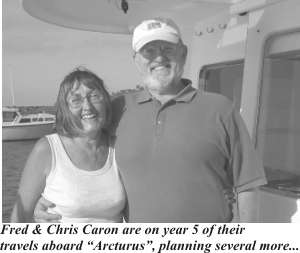
Within hours, the first of the giants catches us and mightily slams Arcturus from her intended course. Picture avalanching snow pushing a house from its foundation and then down a mountainside. The shrieking of our off-course alarm fills the pilothouse. Autopilot off, hands on the helm, we didn't have far to go, we are both here, ready to react. This will not be the last time we are alarmed during the coming hours. This storm is new and the sea is moving in every direction. There is no pattern to the movement, as wave tops are blown off and misted into the air. Arcturus is pushed, shoved, kicked, lifted and dropped. Cold dark waves are hitting us in the face and on the beam at the same time, giant thundering waves of saltwater are cascading down and slamming into our gray hull. The floor is moving constantly under our feet. Like a hapless boxer we stand in a ring ruthlessly and relentlessly punched by a tougher opponent--with no referee to stop
the carnage. It's tiring on the crew and hard on equipment, controlling of the vessel is most important, we know that tired people tend to make mistakes. Yet when off watch, restful sleep is almost impossible. Catnaps are the best we can do.
The sound of storm waves bashing the hull carries throughout the ship. The noise of cold wind as it rushes by, the noise of cold sea as it rushes by. There is no quiet, cold noise is everywhere, cold noise fills our world. Arcturus is lifted and dropped; 60,000 pounds dropped onto the water makes its own noise, like a heavy bomb finding its mark. When she hits, she doesn't shudder, she just stops falling, she is like a heavy cork on salty water. The course we steer is very important to our safety. We can go forward into the on-coming sea or we can retreat but we must avoid being hit directly on either side. We're running with only one stabilizer, a hard hit on either side in these very high seas could cause us to broach, to roll over.
As night approaches, the sea is still unsettled, the hoped-for wave pattern has not evolved. We decide to alter course and ride with the storm throughout the night. We'll allow the storm to push us away from our destination. A following or pushing sea is at times easier to deal with in the dark of night. At dawn, nine hours later, we're still headed away from New Zealand, toward Chile and there is no sign that the storm will slacken any time soon. We alter our course again, this time we steer right into the storm's face. As we bash headlong into the waves, we are making one knot but we are now going in the right direction. Conditions are rough, the white foamy tip of each wave is blown off before it reaches its maximum height. We think we'll be safer and make better time if we steer 15° to 20° to the left of the approaching waves. We do, and now we are making two knots.
Chris is catnapping in the forward stateroom. As another of the giants approaches, my visual world shifts into slow motion. Something is different, something is out of place, something isn't right. As Arcturus rises higher and higher towards the foamy white top, I suddenly realize that this wave is misshapen, it has no backside. There is no water following this wave, there is only air.
There is no downside pewter-colored slope connecting this wave to the next, just air. This giant is a freak, a freak of nature, something I have never seen before and may never see again but it is here, and now we fall. The engine races, the hull vibrates as our huge bronze propeller is slowly lifted from the water and forced into the air as Arcturus slowly tips forward and downward falling headfirst onto the face of the next wave. Thousands of gallons of cold pewter-colored sea water swallows our world as it surges over the bow and then over the pilothouse. In a flash, our world goes black and we are buried. Unearthly sounds accompanied by moans and groans resonates throughout the ship. Then the engine stutters, RPMs fall, but just as quickly it regains its composure and continues on.
For a brief moment, the force of thousands fire hoses had been unleashed at our pilothouse windows. They held. We're mightily jolted, amazed but uninjured. As we move up on to the next wave, Chris quickly goes about checking for damage and out of place items. A drawer here, a cabinet door there, a few kitchen utensils scattered on the floor, but generally everything is fine, our home is still secure. We have taken in water around the pilothouse doors and in the forward stateroom through the dorades, our fresh air intakes. We could have turned the deck funnels, facing them rearward, but it was not an issue, we have never before taken water over the bow, let alone over the pilothouse.
We continue on, steering 15° to the left of head-on into the seas, accompanied by our constant, always present companion--noise. Sometimes hissing, sometimes roaring and sometimes slapping, but always present. These are the highest seas we have yet encountered. After steadily blowing for 38 hours at 50 knots, at times gusting higher, but never much lower, we estimate these waves to be 30 feet or higher. Getting to New Zealand
is proving to be a challenge. A bigger challenge than we expected. Yet, we are not alone, other vessels are out here too, we are not traveling with them but they're out here, in these waters. Force 8, a 44-foot South African sailing vessel decided to heave-to during the worst of it, by the following day she had been blown 80 miles downwind. Another sailing vessel, Rama, was knocked down; she was damaged, but managed to right herself with no injuries to her crew.
Sometime before midnight on the third day the wind died. Just like that, the wind died. It's dawn the following morning, the deep blue color of the sea has returned and the sea is flat, hardly a ripple upon the water--ice rink flat, but not cold. The morning sky is clear, the clearest blue imaginable, transparent. We can see the moon through the sky. Scattered here and there are ghostlike, translucent clouds. The birds are back. The beauty of emptiness, of being alone together, here on this little ship, on this vast body of water, under this boundless sky is absolutely invigorating, soul cleansing. By noon our soul cleansing is complete, the wind is barely breathing at 7 knots but the sea has returned to its normal state. Sleep comes easy, first for Chris then for me, hours later.
In Opua, we talk with others about the passage, the challenge of the ordeal. Some knew and understood what the sea had done, what had happened out there. Force 8 and Rama certainly knew and understood. But it was strange for us to hear that some crews, who started their passage a day or two after we started, did not encounter bad weather. In fact, one fellow, a circumnavigator, said that his passage to New Zealand had been among the easiest he had ever made. We thought he was kidding, he wasn't. He sailed here on good seas with good wind arriving just a day behind us.
It seems odd, but, in a way, so perfectly human that things like this can happen. While some of us are riding out a violent storm, others, close by, are unaware of its presence and unaffected by its impact. These are the things we are thinking as we stop our rental car high on a roadside cliff overlooking the sea, silently watching as an orderly procession of giant ocean waves, remnants of some unnamed and by now forgotten storm, thunderously crash upon boulder-strewn rocks far below...